
Managing land for white-tailed deer often involves food plots, habitat improvements, and efforts to increase the quality of the deer herd. But how much forage does a property actually produce—and is it enough to meet the nutritional needs of the deer using it?
A 2026 study published in the Journal of Wildlife Management examined forage availability on 43 properties managed for white-tailed deer across 25 eastern U.S. states. The findings highlight a potential weakness in many deer-management programs: properties can receive substantial management attention while still providing relatively limited natural forage.
The Big Takeaway
Producing more deer forage may require managing more of the property, not just intensively managing a few food plots or other small areas.
The researchers found that forage availability was limited on most of the properties they studied. Row crops, food plots, and early successional vegetation provided the greatest forage availability, while closed-canopy hardwood forests and pasture or hay fields provided the least.
The central issue was not simply whether a property had food plots or other managed areas. It was how much of the property consisted of vegetation that produced usable, nutritious forage.
For landowners, that means evaluating the entire property—not just the areas that receive the most attention.
What the Researchers Studied
Researchers Mark A. Turner, Craig A. Harper, Bronson K. Strickland, and Marcus A. Lashley evaluated forage availability across 43 properties managed for deer in 25 eastern U.S. states.
They sampled selected plants eaten by white-tailed deer across the major vegetation types found on each property. They then evaluated forage biomass and estimated nutritional carrying capacity using two nutritional constraints:
- 14% crude protein
- 0.3% phosphorus
The researchers also calculated a relative forage contribution value to assess how much each vegetation type contributed to the property’s overall forage availability compared with the amount of land it occupied.
Finally, they modeled scenarios in which forage production was improved and management was expanded to determine how changes in vegetation and management intensity could affect property-wide forage availability.
These measurements allowed the researchers to compare not only which habitat types produced forage, but also how much each contributed to the property as a whole.
What the Researchers Found
1. Closed-Canopy Hardwood Forest Was a Major Limitation
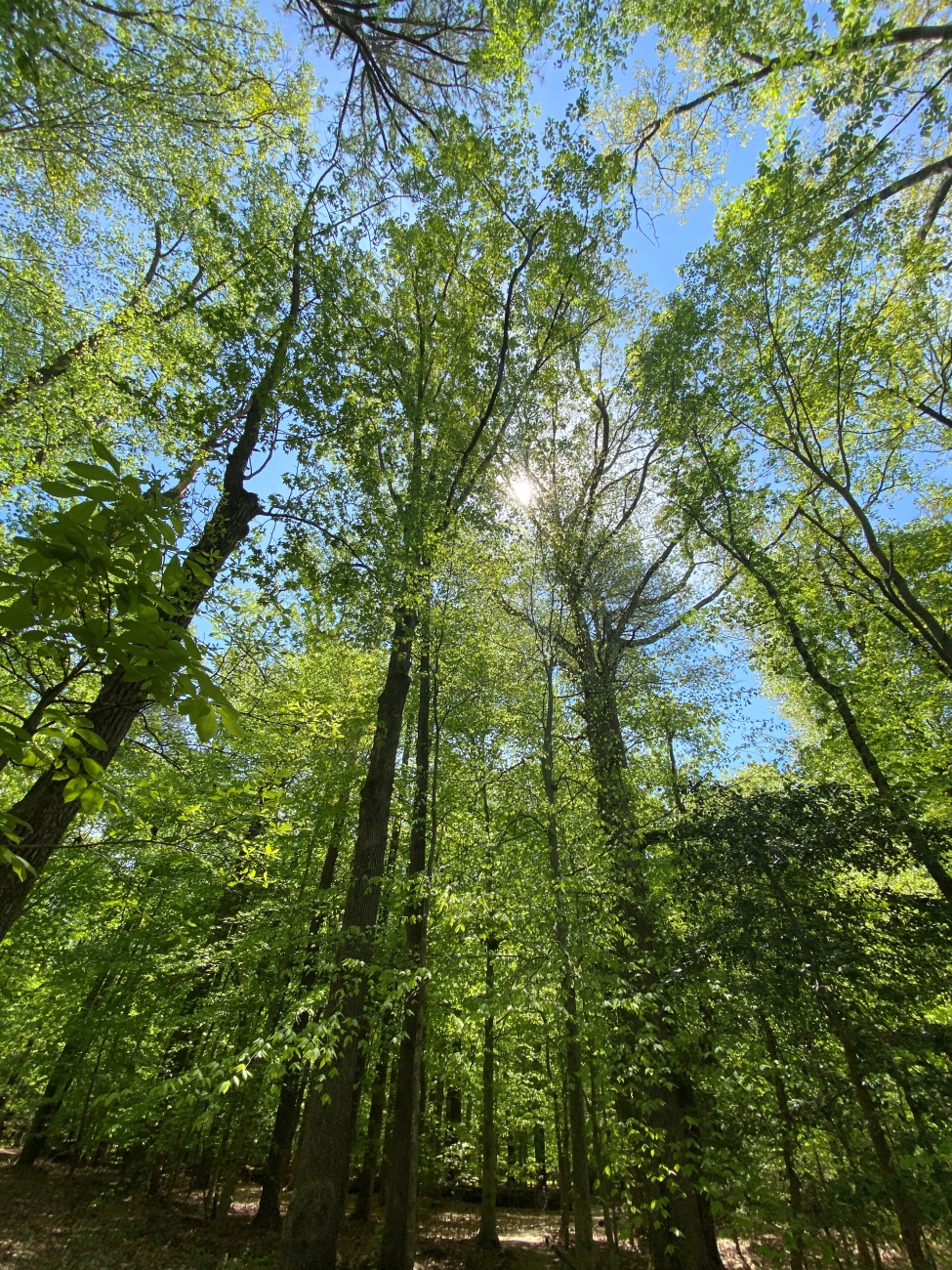
Closed-canopy hardwood forest occupied an average of 62.4% of properties where that vegetation type was present.
These forests generally produced relatively little selected deer forage compared with more open, productive vegetation types. Dense overhead cover limits sunlight reaching the forest floor, restricting the growth of many plants deer consume.
This presents a challenge for properties dominated by mature hardwood timber. A property may contain substantial acreage and excellent-looking timber while producing relatively little forage across much of its area.
That does not mean mature hardwood forests have no value to deer. Forests provide cover, travel routes, and other habitat resources. The finding is specifically about their contribution to forage availability.
The management implication: Landowners should evaluate whether portions of closed-canopy forest could be improved through appropriate canopy reduction or converted to more productive habitat where conditions allow.
2. Early Successional Vegetation Can Contribute Disproportionately to Forage
Early successional vegetation consists of young, regenerating plant communities that develop after disturbance. These areas may contain grasses, forbs, briars, and young woody growth.
When managed appropriately, they can provide abundant vegetation for deer to browse.
The researchers found that early successional vegetation contributed substantially to forage availability relative to the amount of land it occupied. Open-canopy hardwoods and food plots also had relatively high contributions compared with their coverage.
Across properties where the vegetation types were present, open-canopy forest averaged 25.2% of the property and early successional vegetation averaged 17%.
These findings illustrate why habitat composition matters. A relatively small area of productive vegetation can contribute more forage per acre than a much larger area of closed-canopy forest.
However, simply creating an opening does not guarantee good forage production. Plant composition, sunlight, soil conditions, competing vegetation, and management practices all influence the result.
3. Food Plots Alone May Not Solve the Problem
Food plots are a familiar component of deer management, and the study found that they were among the vegetation types providing the greatest forage availability.
But food plots are only one part of the property’s overall habitat.
A property with several productive plots can still have limited total forage if most of its acreage consists of vegetation types that produce relatively little usable food.
The researchers also found that forage estimates from open vegetation types were lower than values reported in previous literature. This suggested that many of the sampled properties were not achieving the forage production possible under more intensive management.
For landowners, this raises an important question: Is the next improvement best made by expanding a food plot, improving an existing plot, or increasing the productivity of surrounding habitat?
The answer depends on the property. In some cases, improving natural vegetation across a larger area may offer more potential than continuing to expand planted plots.
4. The Scale of Management Matters
One of the study’s most important findings was that improving forage production and expanding the area receiving effective management could substantially increase overall nutrient availability.
The researchers modeled scenarios that increased forage production in open vegetation types to levels reported in previous research. These scenarios resulted in substantial increases in estimated property-wide nutrient availability.
It is important to understand what that means: these were modeled scenarios, not measurements demonstrating that every property would achieve the same improvement after a particular treatment.
Nevertheless, the results show why management scale matters. Increasing forage production on a small area can help, but increasing the productivity of a larger portion of the property may have a much greater effect on total forage availability.
For landowners, the practical lesson is to consider both management intensity—how effectively an area is managed—and management scale—how much of the property is managed productively.
What This Means for Your Property
The study provides several useful questions to consider when evaluating a deer-management program.
Evaluate the Whole Property
Estimate how much acreage consists of closed-canopy timber, open woodland, early successional vegetation, food plots, pasture, and other habitat types.
Do not assume that a property produces abundant forage simply because it has food plots or receives regular habitat work.
Look at the Forest Understory
Walk representative areas of your timber and examine how much sunlight reaches the ground, which plants are growing, and whether desirable browse and forbs are abundant.
A forest with a sparse understory may offer opportunities for improvement, although the appropriate treatment depends on the site and management objectives.
Consider Where Additional Management Would Have the Greatest Effect
Rather than automatically expanding an existing food plot, evaluate whether additional productive habitat could be created by opening the canopy, improving early successional vegetation, or managing other suitable areas.
The objective is not to eliminate all mature timber. It is to balance cover and other habitat needs with adequate forage production.
Match Management to Your Objectives
A property managed primarily for hunting may have different priorities from one managed to support a larger deer population or improve body condition and antler development.
Forage is an important part of deer nutrition, but it is not the only factor affecting deer performance. Age, genetics, population density, weather, and other environmental conditions also matter.
What This Study Does Not Tell Us
The results should not be interpreted as proof that increasing forage will automatically produce larger antlers or more deer on every property.
The study evaluated forage availability and estimated nutritional carrying capacity. It did not establish that a particular habitat treatment would produce a specific increase in antler size, body weight, or deer numbers.
The nutritional constraints used by the researchers are useful for comparing forage availability, but estimates of nutritional carrying capacity are not the same as direct measurements of how many deer a property can sustainably support throughout the year.
The study also examined properties across the eastern United States, where vegetation, climate, soils, and growing conditions vary. The best management approach for a particular property will depend on its local conditions.
These limitations do not diminish the study’s value. They help clarify how its findings should be applied: as a framework for evaluating forage resources and identifying potential management opportunities, rather than a guarantee of a particular outcome.
The Bottom Line
A property can be managed for deer without producing as much natural forage as it potentially could.
This study found that closed-canopy hardwood forests occupied a substantial portion of many properties while contributing relatively little forage. More productive vegetation types—including early successional habitat, open-canopy hardwoods, and food plots—made greater contributions relative to their coverage.
For deer managers, the lesson is to look beyond individual food plots and evaluate how the entire property contributes to forage availability.
Improving existing habitat and increasing the acreage devoted to productive vegetation may offer opportunities to improve nutritional resources. The most effective strategy will depend on the property’s current habitat, local growing conditions, and management objectives.
Before investing more in food plots or other improvements, determine where your property produces forage, where it falls short, and which changes could make the greatest difference across the landscape.
Original Research
Turner, M. A., Harper, C. A., Strickland, B. K., & Lashley, M. A. (2026). Management scale and intensity limit forage availability on properties managed for white-tailed deer. The Journal of Wildlife Management, 90(5), e70223.