The Big Takeaway:
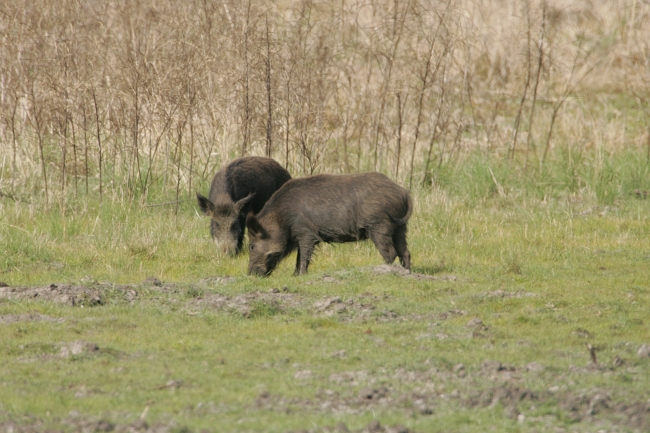
Coyotes are predators. Wild pigs are competitors for food and other resources. But when researchers played recordings of these animals at white-tailed deer feeding sites, deer responded more strongly to the sounds of wild pigs than to the sounds of coyotes.
In an auditory playback experiment, adult bucks and does were most likely to flee after hearing wild pig vocalizations, followed by coyote vocalizations. Pig sounds also reduced feeding time in both sexes, while coyote sounds reduced feeding time in males but not females.
The findings suggest that invasive wild pigs may influence deer behavior through more than direct competition for food. Their presence may also change how deer use feeding areas and respond to potential risks.
There is an important distinction, however: this study measured behavioral responses to recorded sounds. It did not demonstrate that wild pigs have a greater overall effect on deer populations than coyotes, or that pigs cause more mortality.
The Question
Wildlife must balance two competing demands: obtaining enough food and avoiding danger. A deer that abandons a feeding site in response to a perceived threat may reduce its immediate risk, but it also loses feeding time.
Predators such as coyotes can create this trade-off through the risk of being attacked. Competitors can create a different pressure by consuming resources deer need.
The researchers investigated how white-tailed deer responded to sounds associated with a native predator—the coyote—and an invasive competitor—the wild pig. They also examined whether male and female deer responded differently.
What the Researchers Did
Researchers conducted an auditory playback experiment at deer foraging sites. Deer were exposed to vocalizations from three sources:
- Coyotes: a native predator.
- Wild pigs: an invasive species that competes with deer for resources.
- Birds: a non-threatening comparison used as a control.
The researchers observed deer behavior following the sounds. Their measures included whether deer fled, whether they moved away from the sound without leaving the site, how vigilant they were, and how much time they spent feeding.
The experiment allowed researchers to compare responses to perceived predation risk with responses to a potential competitor.
Because the experiment used recorded vocalizations, it tested how deer reacted to the sounds—not every effect that live coyotes or wild pigs might have on deer in the field.
What the Study Found
1. Deer were more likely to flee after hearing wild pigs
Both adult males and females showed their highest probability of fleeing in response to wild pig sounds. Coyote sounds produced the next-strongest flight response.
This result is notable because coyotes are predators, whereas wild pigs were treated in this experiment as competitors. The response suggests that deer may perceive wild pigs as a substantial disturbance or threat at feeding sites.
It does not establish exactly why deer reacted more strongly to pigs. The response could reflect several factors associated with the animals or their vocalizations, and the experiment should not be interpreted as proof that deer universally fear pigs more than predators.
2. Pig sounds reduced feeding time in both sexes
Wild pig vocalizations significantly reduced the amount of time both males and females spent feeding.
Coyote sounds, by comparison, reduced feeding time in males but did not produce the same reported effect in females.
Lost feeding time is one potential cost of disturbance. If similar responses occur repeatedly under natural conditions, they could influence how deer use feeding areas. This experiment, however, does not establish how much feeding time deer lose over an entire day or season, or whether the observed differences affect body condition or antler growth.
3. Does showed a distinct response to pigs
Among deer that did not flee, females responded to pig sounds by moving away from the sound source without abandoning the feeding site. Researchers described this as disturbance.
That response was not reported for males in the same comparison. It suggests that sex can influence how deer respond to competitors and perceived threats.
The researchers also found that females often responded more strongly than males across the behaviors they measured. They proposed that females may be more susceptible to competition and predation risk, although the behavioral results alone do not establish the underlying cause.
4. Coyotes increased vigilance in both sexes
Only coyote sounds increased vigilance in both males and females, according to the study’s reported results.
This is an important distinction. Deer did not respond to both sounds in exactly the same way. Wild pig sounds were associated with stronger flight responses and reduced feeding time, while coyote sounds increased vigilance in both sexes.
Different perceived threats can therefore produce different behavioral responses, even when both disrupt feeding.
Why It Matters for Hunters and Habitat Managers
Wild pigs may affect more than the food supply
Wild pigs are often discussed in terms of their competition with deer for food and their effects on habitat. This study adds a behavioral dimension: deer may alter their immediate activity in response to the presence—or even the sounds—of pigs.
If wild pigs regularly use a property, their effects on deer may not be limited to what the pigs eat. Disturbance could also affect when and how deer use particular feeding areas.
That is a plausible management implication, not a direct result proving that deer abandon specific food plots or change their daily movement patterns because of pigs.
Do not assume deer respond to every threat the same way
For hunters, the study is a reminder that deer behavior is shaped by more than the physical presence of predators. The type of disturbance matters, and deer may respond differently depending on the source.
But the findings do not establish a reliable hunting tactic. They do not show that wild pig sounds will consistently displace deer, that deer will avoid areas where pigs have been present, or that hunters can predict deer movement from these responses.
Sex differences deserve attention
Males and females did not respond identically to the playback treatments. This matters when interpreting deer behavior and designing future research on disturbance, competition, and habitat use.
However, the study should not be used to conclude that does are always more wary than bucks. The results apply to the specific behaviors and conditions examined.
What This Study Does NOT Tell Us
This is where the limits of the findings matter.
- It does not prove that wild pigs are more dangerous to deer than coyotes. The experiment compared behavioral responses to sounds, not actual attack rates, injuries, or mortality.
- It does not measure population-level effects. The reported findings do not establish whether wild pigs reduce deer abundance, reproduction, or survival through these behavioral responses.
- It does not prove that pigs reduce antler growth or body condition. Reduced feeding time during the experiment is not the same as demonstrating a long-term nutritional consequence.
- It does not establish that deer will avoid areas occupied by wild pigs. The experiment examined immediate responses at feeding sites, not long-term habitat selection.
- It does not show that all deer populations respond the same way. Responses may vary with local conditions, previous exposure, pig and coyote activity, and other factors not resolved by the abstract.
The study provides evidence that deer respond strongly to wild pig vocalizations under the experimental conditions. Broader conclusions about the effects of wild pigs on deer populations require additional evidence.
The Bigger Picture
Wildlife competition is not only about which species consumes the same food. Animals also make behavioral decisions in response to the risks and disturbances associated with other species.
In this study, wild pig sounds produced stronger flight responses than coyote sounds, while the two sound types produced different patterns of vigilance and feeding disruption. That makes invasive wild pigs a potentially important subject for further research into deer behavior.
The practical question for managers is how these short-term responses translate into real-world effects. Do deer consistently change feeding locations or activity when pigs are present? Do those changes persist long enough to affect nutrition or habitat use? And do the effects differ among properties and seasons?
This experiment raises those questions; it does not answer all of them.
Bottom Line
White-tailed deer in this experiment reacted more strongly to wild pig sounds than to coyote sounds, and pig sounds reduced feeding time in both sexes. The findings suggest that invasive wild pigs may disturb deer as well as compete with them for resources.
The evidence is about behavioral responses—not proof that wild pigs have a greater overall impact on deer populations than coyotes. Understanding that distinction is essential when turning an interesting research result into a management decision.
Original Research
Trifiletti, P. C., L. M. Conner, S. B. Jack, et al. 2026. “Fear of the Super Competitor? Deer Respond More Strongly to Pigs than Coyotes.” Scientific Reports. Published October 5, 2026.
Read the original peer-reviewed study
Support DeerManagers
DeerManagers translates peer-reviewed white-tailed deer research into useful information for hunters, habitat managers, and herd managers. If you find these research breakdowns valuable, consider supporting our work so we can continue reviewing new studies and explaining what the evidence does—and does not—show.