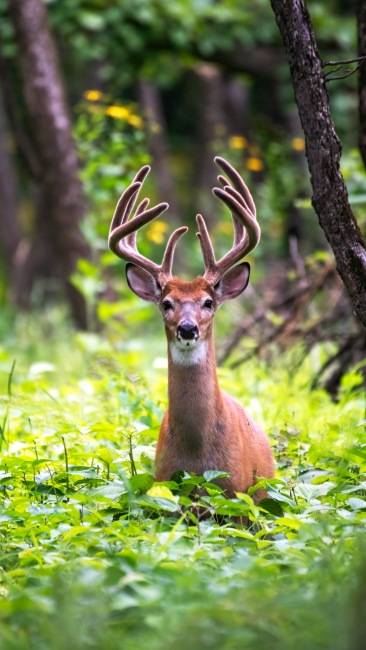
New research suggests that visibility around a fawn’s bedsite may matter for survival—but the findings don’t mean thick cover is unimportant.
The Big Takeaway
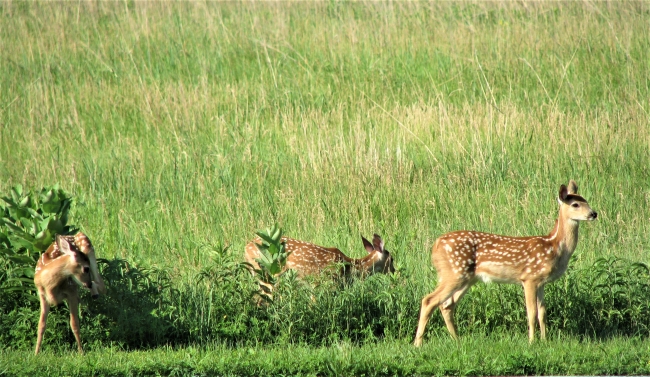
White-tailed deer fawns depend on hiding to avoid predators during their first days of life. But hiding may not be the whole story.
A 2026 study in south-central Minnesota found that bedsites where fawns survived had greater horizontal visibility than sites where coyotes killed fawns. Surprisingly, researchers found no significant differences in vegetation height or fawn concealment between surviving and mortality bedsites.
The findings suggest that the habitat immediately surrounding a bedded fawn may influence its ability to detect an approaching threat. They also reinforce the importance of providing a variety of habitat structures rather than assuming that thicker vegetation always offers better protection.
For deer managers, the lesson isn’t to eliminate dense cover. It’s to consider how hiding cover, visibility, and escape opportunities work together.
What Did Researchers Study?
In a study published in The Journal of Wildlife Management in July 2026, Tyler R. Obermoller, Eric S. Michel, and Joseph K. Bump examined how white-tailed deer fawns used their bedding sites and whether vegetation characteristics differed between sites where coyotes killed fawns and sites associated with surviving fawns.
Researchers captured and GPS-collared 261 fawns in south-central Minnesota between 2021 and 2023. The landscape was dominated by row-crop agriculture, with grasslands, wetlands, and relatively limited forest cover.
The researchers documented 82 coyote predation deaths. They were able to confidently identify the precise mortality bedsite for 45 of those events.
They compared vegetation characteristics at the mortality bedsites with two types of comparison sites: earlier capture bedsites used by the same fawns and nearby paired bedsites used by surviving fawns of similar ages.
Researchers measured several characteristics, including:
- Horizontal visibility: How much of the surrounding area could be seen from a bedsite.
- Vegetation height: The height of herbaceous and woody vegetation around the site.
- Fawn concealment: How well vegetation concealed a bedded fawn.
- Overstory cover: The amount of overhead tree cover.
The goal was to determine whether particular bedsite characteristics were associated with fawn survival or coyote predation.
What Did the Researchers Find?
Surviving fawns had greater horizontal visibility
The clearest finding involved horizontal visibility.
In comparisons between mortality bedsites and paired bedsites used by surviving fawns, surviving fawns had an average horizontal visibility of 45.5%, compared with 30.0% at mortality sites.
Researchers also compared mortality sites with earlier capture sites used by the same fawns. In that analysis, capture sites averaged 55.3% horizontal visibility, compared with 32.9% at mortality sites.
These results indicate that fawns were associated with bedsites offering greater visibility when compared with the sites where coyotes killed them.
Greater visibility could help a fawn detect an approaching predator sooner, potentially providing more opportunity to remain undetected or escape as it becomes more mobile. However, the study measured visibility around bedsites; it did not directly measure how often fawns detected coyotes before an attack.
More vegetation didn’t necessarily mean better concealment
Researchers found no statistically significant differences in vegetation height or fawn concealment between mortality bedsites and the comparison sites.
That result is important, but it needs careful interpretation.
It doesn’t demonstrate that vegetation height and concealment never affect fawn survival. Instead, the researchers did not find evidence that those measurements consistently distinguished mortality sites from the comparison sites in this study.
The results suggest that simply measuring how tall or thick the vegetation is may not fully capture the differences that matter when fawns encounter predators.
A fawn’s behavior changes as it grows
White-tailed deer fawns rely on different strategies as they develop.
Very young fawns generally use a hider strategy. They spend much of their time lying still and relying on concealment to avoid detection.
As they grow more mobile, fawns increasingly adopt a follower strategy, relying more on movement and their ability to flee from danger.
The researchers examined bedsite characteristics in relation to these different stages. They observed patterns suggesting that hiders tended to use sites with more overhead cover, while followers tended toward less overhead cover that may provide better visibility and potential escape routes.
However, the researchers did not find statistically significant differences in bedsite characteristics between the two strategies. Those patterns should therefore be treated as suggestive rather than conclusive.
The broader point is that the value of a particular habitat structure may change as a fawn develops.
What Does This Mean for Deer Managers?
The study offers a useful reminder that fawning habitat is more complicated than vegetation height or thickness alone.
For managers, the most defensible takeaway is to maintain a diversity of habitat structures that can provide concealment, visibility, and escape opportunities.
Don’t assume all dense cover is good—or bad
Thick vegetation can provide places where young fawns remain concealed. But the Minnesota findings suggest that the surrounding field of view may also matter.
That doesn’t justify clearing brush throughout a property or thinning every dense area. The researchers did not test a habitat-clearing treatment or establish that removing vegetation would improve fawn survival.
Instead, evaluate whether your property provides a range of conditions: suitable ground-level cover, grassland or other herbaceous habitat, woody cover, and transitions among these areas.
Think about habitat as a mosaic
The authors recommend maintaining a heterogeneous mix of cover types used by fawns, including grasslands, forests, and wetlands, with varying overstory and understory structures.
That recommendation is particularly relevant to the agricultural landscape where the study was conducted.
On an individual hunting property, the appropriate mix will depend on the existing vegetation, landscape, soils, and surrounding habitat. A property with extensive open fields and little woody cover presents different management questions from one dominated by closed-canopy timber.
The study does not establish a universal recipe for fawning habitat. It supports considering multiple habitat features together rather than managing for a single vegetation characteristic.
Keep the limits of the findings in mind
The research focused on bedsite characteristics associated with coyote predation in south-central Minnesota. It did not establish that the same relationships will be equally strong in every region, vegetation type, or deer population.
Nor did it test whether changing horizontal visibility through habitat management would reduce coyote predation. The findings identify an association, not proof that deliberately opening up a site will cause more fawns to survive.
For landowners, the best use of this research is to consider visibility as one possible component of fawn habitat—not to replace established habitat-management principles with a single new rule.
Important Limitations
There are several reasons to avoid drawing overly broad conclusions from this study.
First, although researchers GPS-collared 261 fawns, they confidently identified the mortality bedsite for 45 of the 82 documented coyote predation events. The principal bedsite comparisons therefore involved smaller samples than the total number of collared fawns.
Second, the study was observational. Researchers compared the characteristics of sites associated with different outcomes; they did not experimentally manipulate vegetation to test whether increasing visibility caused survival to improve.
Third, the study landscape was dominated by agriculture and contained relatively little forest. Relationships between bedsite structure and predation risk may differ in other regions.
Finally, coyote predation is only one source of fawn mortality, and bedding habitat is only one part of a fawn’s survival equation. Maternal behavior, predator activity, weather, nutrition, and other factors may also influence outcomes.
The authors recommend maintaining diverse habitat structures while recognizing that additional research is needed to better understand how fawns, predators, and habitat interact.
The Bottom Line
Fawns need ways to avoid detection, but concealment alone may not explain why some bedsites are associated with survival and others with coyote predation.
In this Minnesota study, sites associated with surviving fawns had greater horizontal visibility, while vegetation height and measured concealment did not differ significantly from mortality sites.
For deer managers, that suggests a more complete approach to habitat: provide appropriate hiding cover while maintaining a variety of vegetation structures and potential escape opportunities.
It does not mean thick cover is bad, that brush should be cleared, or that increasing visibility will automatically increase fawn survival. It means the arrangement of habitat may matter in ways that a simple measurement of vegetation height cannot capture.
Original Research
Obermoller, T. R., Michel, E. S., & Bump, J. K. (2026). The art of avoidance: bedsite use, antipredator strategies, and predation risk in white-tailed deer fawns. The Journal of Wildlife Management, 90(7), e70240.
Read the original peer-reviewed study
Discover more from DeerManagers
Subscribe to get the latest posts sent to your email.