
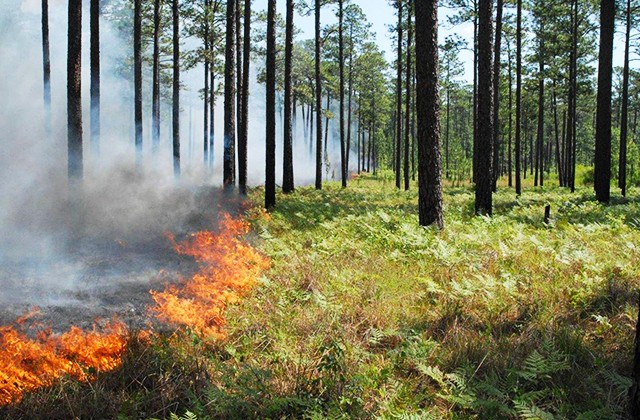
What a New Study Found About Managing Loblolly Pine Stands for Deer
Pine plantations can provide valuable deer habitat, but producing more nutritious forage requires more than simply opening the canopy. As vegetation develops, woody plants and vines can overtake the understory, competing with the forbs and other plants that provide valuable nutrients to deer.
A study published in Wildlife Society Bulletin examined how thinning intensity, prescribed fire, and herbicide applications affected forage availability and nutritional carrying capacity for white-tailed deer in five mid-rotation loblolly pine stands in central Georgia.
The findings offer practical guidance for managers who want to maximize the nutritional value of deer habitat while controlling management costs. They also highlight why thinning intensity and repeated disturbance matter when the objective is to maintain high-quality forage over time.
The Big Takeaway
For managers prioritizing deer nutrition over timber production, the research supports thinning loblolly pine stands heavily and using recurring prescribed fire to maintain productive understory vegetation.
The lowest residual basal-area treatment produced the highest estimated nutritional carrying capacity (NCC). At the study’s 14% crude-protein requirement for lactation, NCC estimates in plots receiving prescribed fire alone or prescribed fire combined with herbicide were approximately 160% greater than in thinning-only controls by the second growing season after treatment.
Prescribed fire was also the least costly treatment evaluated for maintaining high NCC.
However, the results varied by nutritional requirement and year. The 160% increase was a specific second-year comparison, not a consistent advantage across the entire study. When results were averaged across both sampling years, thinning-only controls had the greatest estimated NCC under both the maintenance and lactation protein requirements.
Understanding those differences helps clarify how managers can apply the findings.
How Researchers Tested the Treatments
Researchers evaluated five mid-rotation loblolly pine stands in central Georgia. In 2017, the stands were thinned to three target residual basal-area levels:
- 9 m²/ha: approximately 39 square feet per acre.
- 14 m²/ha: approximately 61 square feet per acre.
- 18 m²/ha: approximately 78 square feet per acre.
Researchers then compared four treatment combinations: thinning only, thinning plus prescribed fire, thinning plus herbicide, and thinning plus both fire and herbicide.
Prescribed burns took place in spring 2018 and spring 2020. The herbicide mixture, imazapyr plus metsulfuron methyl, was applied in fall 2019. Researchers measured forage availability and estimated NCC in June 2020 and June 2021.
To evaluate whether the available forage could meet different nutritional demands, they calculated NCC using two crude-protein requirements: 6% for maintenance and 14% for lactation.
NCC estimates the number of deer-days of nutritional support available per unit of land under specified dietary requirements. It is not a direct count of deer, nor does it demonstrate that a treatment increased deer populations or improved reproductive success.
What the Researchers Found
1. Heavier thinning produced the highest estimated carrying capacity
NCC was greatest in the lowest basal-area treatment, targeting 9 m²/ha. The medium and high basal-area treatments did not differ significantly from one another.
Reducing the remaining pine density allows more sunlight to reach the forest floor, creating opportunities for understory vegetation to develop. The study’s results support the importance of thinning intensity when the management goal is to maximize deer forage in mid-rotation pine stands.
The authors’ broader management recommendations, presented in the related 2022 master’s thesis, indicate that managers prioritizing deer NCC over timber production could approximately double NCC by reducing residual basal area from 14 to 9 m²/ha.
That comes with a trade-off. More intensive thinning may reduce the financial return from timber production, so landowners must decide how much weight to give wildlife habitat relative to timber objectives.
For properties managed primarily for deer, however, conservative thinning may leave potential forage production on the table.
2. Prescribed fire improved high-protein carrying capacity estimates
One of the most relevant findings for deer managers involved the 14% crude-protein requirement, which researchers used to represent lactation demands.
By the second growing season after treatment, estimated NCC under this requirement was approximately 160% greater in fire-only and fire-plus-herbicide plots than in thinning-only controls.
This result supports prescribed fire as a tool for maintaining vegetation capable of meeting higher nutritional demands.
The distinction between protein concentration and NCC is important. The 160% figure represents an increase in estimated nutritional carrying capacity under the 14% protein constraint. It does not mean that the plants themselves contained 160% more protein.
The study also found that fire and herbicide treatments reduced estimated NCC by 52% to 97% under the 6% crude-protein maintenance requirement. Across both sampling years, the thinning-only controls had the highest average NCC under both protein constraints.
These findings may seem contradictory, but they highlight how treatment effects can change over time and depend on the nutritional objective used to evaluate habitat.
For managers focused on supporting deer during periods of elevated nutritional demand, the second-year results are particularly relevant. They should not, however, be interpreted as proof that prescribed fire will outperform untreated stands under every condition.
3. Repeated fire can help keep nutritious vegetation within reach
Thinning can improve growing conditions, but the understory continues to change after treatment.
As woody vegetation and vines mature, they can develop into a midstory, compete with protein-rich forbs, and place forage beyond the reach of browsing deer. A stand that initially produces abundant forage may become less favorable as vegetation grows and the structure of the understory changes.
The thinning-only controls experienced a decline in estimated NCC between the two sampling years. Researchers suggested that increasing plant height and maturation of woody vegetation likely contributed to the decline.
The authors’ related thesis recommends repeated prescribed fire on a two- to four-year interval, depending on management objectives, to limit woody encroachment and maintain favorable understory vegetation.
The interval itself was not experimentally compared against other burn schedules in this study. Researchers burned plots in spring 2018 and spring 2020, so the research supports recurring disturbance but does not establish that a two-year interval is always better than a three- or four-year interval.
For managers prioritizing high-quality forage, the practical lesson is to consider prescribed fire as an ongoing management practice rather than a one-time habitat improvement.
4. Herbicides can remove valuable deer forage along with competing vegetation
Herbicide applications produced a more complicated result.
In the study, blackberries, American beautyberry, and grapes collectively accounted for 85% of the cumulative plant biomass collected in untreated control plots. The herbicide-only and herbicide-plus-fire treatments reduced those plants by 92% and 95%, respectively.
Because these plants contributed substantially to the available forage, their removal reduced NCC estimates under both nutritional constraints.
However, the response did not end there. The related thesis reported that forbs responded favorably by the second year after herbicide treatments as competition declined. Under a separate 16% crude-protein constraint examined in the thesis, estimated NCC in herbicide and combined-treatment plots exceeded that of the untreated controls.
That suggests herbicide can shift plant composition toward herbaceous forage, but the benefits may take time to emerge and come at the expense of existing browse.
Managers should therefore avoid assuming that a standard herbicide tank mix will automatically improve deer habitat. Where valuable woody forage is abundant, its removal can initially work against the objective of maximizing NCC.
The authors’ findings support viewing herbicide as a targeted option when woody vegetation has become a significant management problem, rather than an automatic addition to every thinning or burning program.
What About Cost?
Prescribed fire was the least costly secondary treatment evaluated.
The cost estimates used in the authors’ thesis averaged approximately $86 per hectare for prescribed fire, $148 per hectare for herbicide, and $234 per hectare for the combined treatment. These are project-era estimates rather than current contractor quotes, and actual costs will vary by location, acreage, access, and site conditions.
The relative difference is still important. Combining treatments cost substantially more than either treatment alone, and the combination did not consistently produce the highest NCC.
For a landowner trying to maintain nutritious forage over many years, prescribed fire offers a potentially cost-effective way to manage understory vegetation without repeatedly relying on more expensive chemical treatments.
What This Means for Deer Managers
The study points to three practical considerations for managers working with mid-rotation loblolly pine.
Prioritize the management objective. If maximizing deer nutrition takes precedence over maximizing timber production, consider lower residual basal area when planning a commercial thinning. The lowest target basal-area treatment in this study produced the greatest estimated NCC.
Plan for recurring disturbance. Thinning opens the canopy, but it does not permanently maintain the understory. The authors recommend a two- to four-year prescribed-fire interval depending on management objectives. The right schedule will depend on the site’s response and the vegetation a manager wants to maintain.
Use herbicides selectively. Removing competing woody plants can encourage forbs, but it can also eliminate highly productive browse species and reduce NCC in the short term. Evaluate what the existing understory contributes before deciding whether chemical treatment is necessary.
These recommendations apply most directly to mid-rotation loblolly pine stands similar to those studied in central Georgia. Hardwood forests, mixed forests, and other habitat types may respond differently. Managers should also consider how their treatments affect cover and vegetation diversity, not just forage production.
The Bottom Line
Producing high-quality deer forage in pine plantations requires both the right initial conditions and a plan to maintain them.
The research supports heavier thinning when deer nutritional carrying capacity is a primary objective, while the authors’ broader management recommendations emphasize repeated prescribed fire to keep woody vegetation from overtaking the understory.
Prescribed fire was the least costly treatment evaluated, and its effects on estimated carrying capacity under the higher protein requirement make it particularly relevant to managers interested in meeting greater nutritional demands.
The exact results depend on the nutritional requirement and the time since treatment. The study does not prove that more frequent burning always produces higher carrying capacity, nor does it identify one universally optimal fire interval.
The practical lesson is to manage for the forage deer need, account for how that forage changes over time, and choose treatments that maintain those conditions at a sustainable cost.
Sources
Stewart, D. G., Greene, D. U., Martin, J. A., Ditchkoff, S. S., Johannsen, K. L., Lewis, W., & Gulsby, W. D. (2026). “Effects of forest treatments on nutritional carrying capacity for white-tailed deer in mid-rotation loblolly pine stands.” Wildlife Society Bulletin.
Stewart, D. G. (2022). Effects of Thinning Intensity, Prescribed Fire, and Herbicide on Wildlife Habitat in Mid-rotation Loblolly Pine Stands. Master’s thesis, Auburn University.