
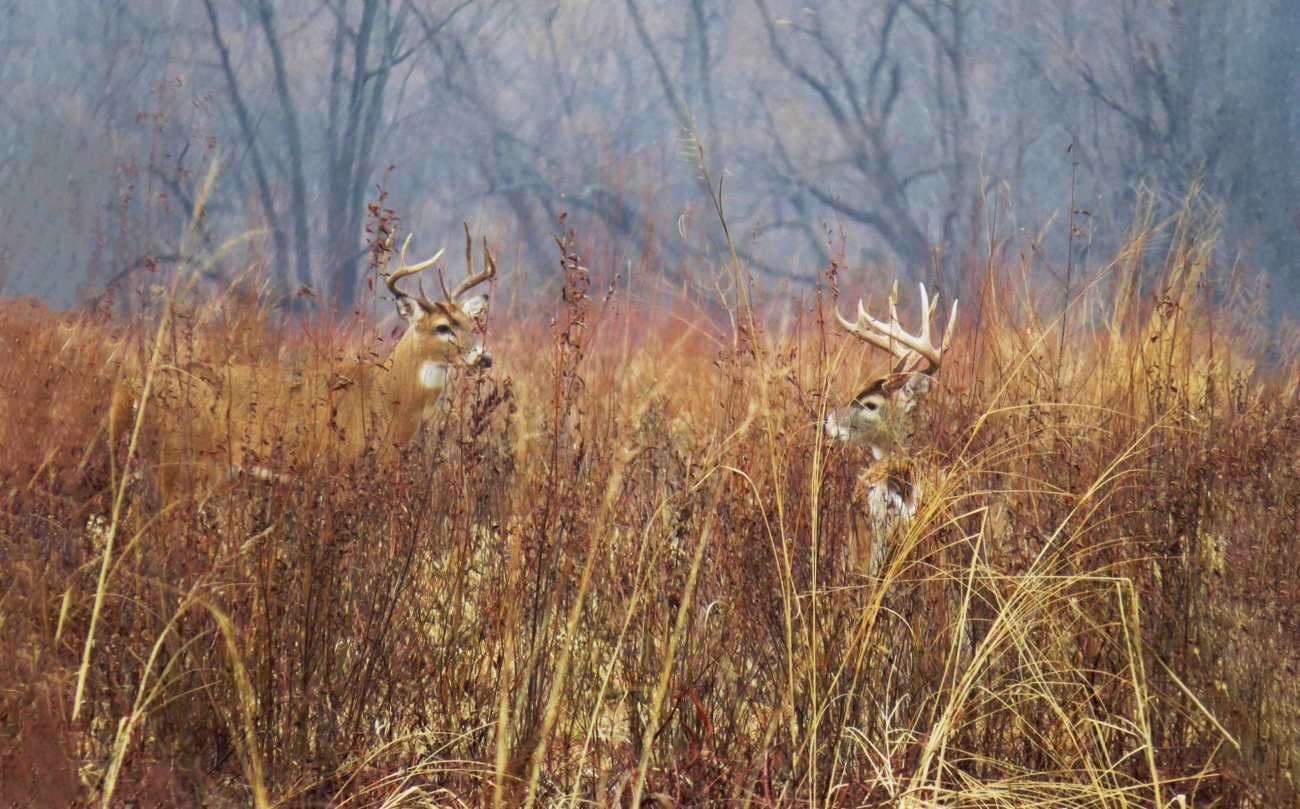
Researchers tracked 188 male white-tailed deer for four years to examine breeding-season movement, age-related differences, and whether hunting-season timing affected their behavior.
The Big Takeaway
Buck movement during the rut follows a stronger seasonal pattern than many hunters might realize. In a four-year study in southwestern Wisconsin, GPS-collared bucks showed a sharp increase in movement leading into peak breeding activity, followed by a gradual decline. Two-year-old bucks had the highest average hourly movement rates, while older bucks showed greater variation in their daily movements.
The researchers also found that the timing of firearm season did not significantly explain movement rates or daily range size. Movement was already declining before the season opened.
That result doesn’t establish that hunting pressure has no effect on deer. It suggests that the seasonal breeding cycle was a more useful explanation for the movement patterns observed in this study.
What Did Researchers Study?
In a study published in Ecology and Evolution in July 2025, Matthew Hunsaker and colleagues examined the breeding-season movement of male white-tailed deer in southwestern Wisconsin.
The researchers analyzed GPS data from 188 collared bucks collected between 2017 and 2020. The collars recorded locations hourly from October 15 through December 1, allowing researchers to calculate hourly movement rates and daily range sizes.
They compared movement among three age groups:
- Yearlings
- Two-year-old bucks
- Bucks three years old and older
They also evaluated temperature, calendar date, and hunting-season timing, distinguishing archery season, the opening weekend of firearm season, and the remainder of firearm season.
To estimate when breeding activity peaked, the researchers compared movement patterns with estimated conception dates derived from fawn capture data.
This combination of continuous GPS tracking and reproductive data allowed them to examine not just when bucks moved most, but whether those movements corresponded with the timing of breeding.
What Did the Study Find?
1. Peak breeding activity occurred between October 23 and November 12
Using statistical analysis of movement rates, daily range sizes, and estimated conception dates, researchers identified October 23 through November 12 as the peak breeding period in southwestern Wisconsin.
Movement increased substantially from mid-October into the breeding peak, with the highest rates occurring around November 1–7. Average movement rates more than doubled between October 15 and the peak.
Movement then tapered off as the breeding season progressed.
The close agreement between GPS-derived movement patterns and estimated conception dates strengthens the interpretation that the observed changes reflected breeding activity rather than simply random variation in deer movement.
However, this is a regional result, not a universal rut calendar. Breeding timing differs geographically, and hunters should not assume the Wisconsin dates apply directly to their own properties.
2. Two-year-old bucks had the highest average movement rates
Two-year-old bucks had higher hourly movement rates than the other age groups and larger daily ranges than both yearlings and older bucks.
Their average peak movement rate was more than 10% higher than that of yearlings and bucks three years old and older.
That finding may seem counterintuitive to hunters who expect mature bucks to be the most active during the rut. But average movement rates don’t necessarily reflect how much time a buck spends searching for does versus remaining with a receptive doe.
A buck searching for a mate may cover substantial ground. Once it locates a receptive female, it may spend extended periods in a relatively small area.
Consequently, a mature buck can have a lower average movement rate than a younger buck without necessarily being less involved in breeding.
The researchers suggested that older bucks may spend more time tending receptive females, which could help explain their lower average movement rates.
GPS movement alone, however, cannot establish the reproductive success of an individual buck.
3. Older bucks showed greater variation in daily movement
Bucks three years old and older showed the greatest variation in daily movement rates.
This is an important distinction. Their movement was not simply consistently high or consistently low. Instead, the pattern was more variable from one day to the next.
The researchers suggested that this could reflect older bucks alternating between mate searching and tending receptive females.
For hunters, this offers a useful perspective on why a buck might make substantial movements one day and remain within a relatively small area the next.
A temporary reduction in movement doesn’t necessarily mean a buck has abandoned an area or stopped participating in the rut.
4. Movement declined before firearm season opened
The researchers found no statistically significant relationship between movement rates and hunting-season timing. The same was true for daily range size.
Movement declined during the opening weekend and the remainder of firearm season, but the decline was better explained by calendar date. The downward trend had already begun before the firearm season opened.
This is an important result, but it requires careful interpretation.
The researchers did not demonstrate that hunting pressure has no effect on deer behavior. Their analysis found that firearm-season timing did not significantly explain the movement patterns observed in this population.
Nor does the result establish that bucks never reduce daytime movement in response to disturbance.
Instead, it indicates that the seasonal pattern of breeding-related movement was a stronger explanation for the observed decline than the timing of the firearm opener.
Does the Opening Day Tell the Whole Story?
For hunters, the firearm-season finding raises another question: what happens before opening day?
Human activity often increases well before firearm season begins. Hunters scout, check trail cameras, trim shooting lanes, place stands, and repeatedly enter hunting areas. Deer may encounter this activity during the weeks leading up to opening day.
The opening of a hunting season is a clear administrative date, but it is not necessarily the beginning of human disturbance for deer.
If deer alter their behavior in response to earlier intrusion, changes could occur before the firearm season begins. Seasonal changes in breeding activity could also influence movement at the same time.
However, the Wisconsin study did not directly measure scouting activity, stand placement, or the amount of human intrusion experienced by individual deer. It therefore cannot determine whether earlier disturbance contributed to the observed decline.
The most defensible conclusion is that movement was already declining before firearm season and that the statistical analysis did not identify a significant effect of hunting-season timing.
Determining whether pre-season disturbance changes movement would require research that measures human activity and evaluates deer responses across the relevant periods.
What Does This Mean for Hunters and Deer Managers?
Don’t assume every buck responds to the rut the same way
Age-related differences suggest that bucks can exhibit different movement patterns during breeding season. A buck covering more ground may be searching for does, while one moving less may be tending a receptive female.
These are possible explanations, not behaviors that can be reliably diagnosed from a single trail-camera photograph.
Interpret movement in the context of the calendar
The study found that calendar date was an important predictor of movement. The breeding cycle helps explain why bucks become more active during a relatively concentrated period and why movement subsequently declines.
For hunters, this means a change in movement should be considered alongside the timing of the rut rather than automatically attributed to weather or hunting pressure.
Consider cumulative human intrusion
The study doesn’t establish how much scouting or stand placement affects deer movement, but it highlights a question worth considering in practical management.
When evaluating deer activity on a property, managers should consider the timing and frequency of human entry, not just whether a hunting season is open.
Keeping disturbance low where practical is a reasonable management consideration, although this particular study doesn’t quantify the benefit of doing so.
Don’t apply Wisconsin rut dates everywhere
The October 23–November 12 breeding window describes southwestern Wisconsin. Local breeding timing can differ, so hunters should combine published research with regional information and observations from their own areas.
What the Study Doesn’t Tell Us
Several limitations are important when applying these findings.
First, the study was conducted in one region of Wisconsin. Its specific breeding dates and movement patterns should not automatically be applied to other states.
Second, the researchers did not directly measure the amount of human intrusion experienced by individual bucks. The study cannot determine whether scouting and other pre-season activity affected movement.
Third, the lack of a statistically significant hunting-season effect does not prove that hunting pressure has no influence on deer. It means the study did not detect a significant relationship between hunting-season timing and the movement measures analyzed.
Finally, GPS movement rates do not directly measure breeding success, the probability of encountering a buck while hunting, or the effectiveness of a particular hunting tactic.
These distinctions matter because a finding about movement in one population is not a guarantee of how an individual deer will behave.
The Bottom Line
This study provides a useful picture of how male white-tailed deer move during the breeding season. In southwestern Wisconsin, movement increased sharply into peak breeding activity, two-year-old bucks had the highest average hourly movement rates, and older bucks showed greater day-to-day variation.
Movement subsequently declined, and the researchers found that calendar date explained the pattern better than firearm-season timing.
For hunters, the important lesson is not that hunting pressure never changes deer behavior. It’s that breeding activity and age-related behavior can strongly influence movement, and those influences need to be considered before attributing a change to hunting pressure.
The study also leaves an important question unanswered: how much does human intrusion before opening day affect deer movement? Answering that would require research that directly measures disturbance, rather than using the opening of firearm season as a proxy for it.
Research Source
Hunsaker, M. A., Gilbertson, M. L. J., Storm, D. J., and Turner, W. C. (2025). “The Breeding Season and Movement Ecology of Male White-Tailed Deer in Southwest Wisconsin.” Ecology and Evolution, 15(7), e71589.
Read the full peer-reviewed, open-access study.
Additional background: The Wisconsin Department of Natural Resources published a helpful account of the research, including movement graphs and an example of an individual buck tracked over three breeding seasons.
Where’d That Buck Go? Buck Movement Ecology During the Rut — Wisconsin DNR